
What the SAP learning resource covers
The walkthrough sits within the SAP S/4HANA Cloud Public Edition 2608 documentation. It links an amended contract end date to completing the valuation. Its interactive example starts the valuation time slice on the day following termination. SAP identifies separate roles for contract changes and valuation. Source: SAP Help Portal.
The German summary and interactive steps describe the time-slice start differently. Check date handling in your own system. The walkthrough reaches valuation completion; the subsequent posting control below is our own addition.
Our process view: from the business event to reconciled documents
This is an original control model by Niederhauser Consulting, rather than a SAP screen or a prescribed sequence of clicks.
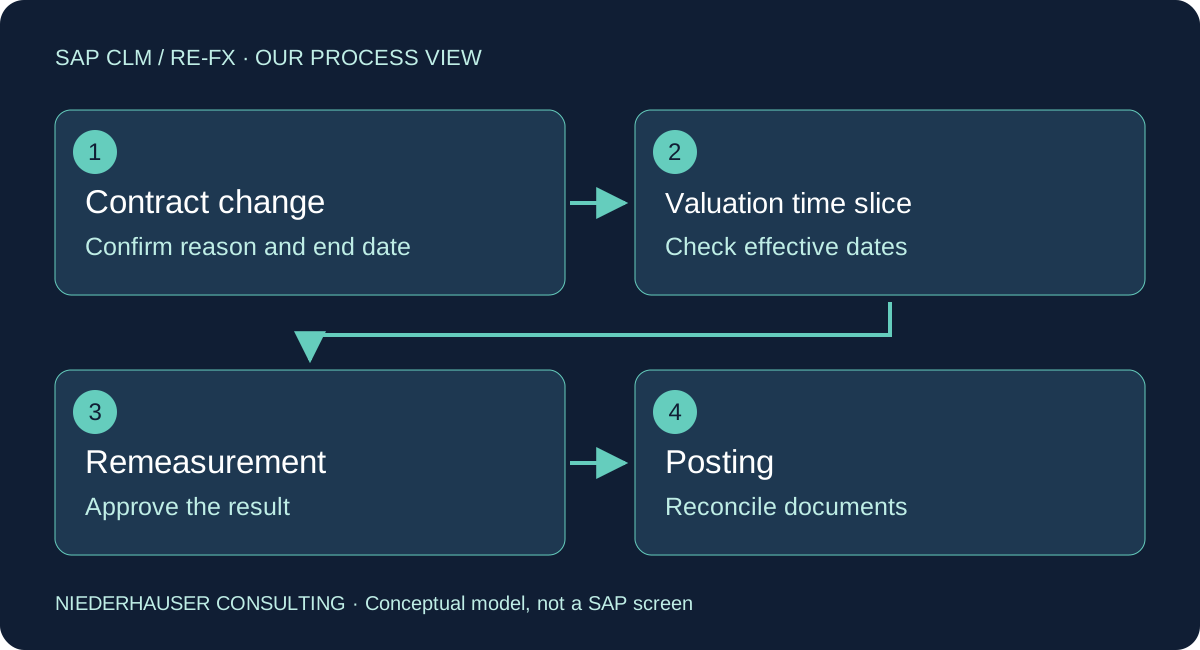
Contract change: establish what actually happened
Record whether the early end follows an existing termination option, a reassessment of the lease term or a newly negotiated agreement. Distinguish the agreement date, effective date, final day of use and outstanding payments. Keep the rationale for any compensation or final invoice with the supporting contract documentation.
Valuation time slice: establish a consistent boundary
Align the contract term, condition validity and the valuation’s effective dates. Check that the final day of use and the following day are treated consistently. Retain the previous valuation for comparison. The appropriate time slice depends on the event and the solution in use.
Remeasurement: make the movement explainable
Compare the previous and revised payment schedules and valuation results. Investigate payments extending beyond the effective end date, confirm any settlement payment and check that the treatment of the discount rate follows the accounting assessment. Approve the result only once the movement from the previous position can be explained.
Posting: demonstrate the handover to Finance
A completed valuation does not establish that the accounting documents reconcile. Check the intended posting run, open periods, account determination and Asset Accounting integration. Reconcile the valuation result to the lease liability, right-of-use asset and any profit or loss effect. Explain residual balances instead of treating a blanket write-off as evidence of completion.
IFRS 16: classify the event before choosing the treatment
For a lessee, reassessing an existing termination option differs from negotiating a lease modification. IFRS 16.20–21 and 39–43 address reassessment and remeasurement; paragraphs 44–46 govern modifications. For a modification reducing the scope of a lease, the right-of-use asset is reduced accordingly and any related gain or loss is recognised. The liability is remeasured under the applicable modification requirements. Assess compensation against the actual contractual terms. Source: IFRS 16.
The contractual event, lease-term assessment and system processing need to agree. Selecting a SAP status does not itself establish the IFRS 16 treatment.
Implications for SAP CLM and RE-FX
The ownership and control principles also provide a useful framework for RE-FX projects. However, apps, statuses, valuation rules and posting procedures need to be checked against the specific release and deployment model. A Public Cloud walkthrough does not promise identical behaviour in Private Cloud or on-premise RE-FX.
For acceptance, use a complete case linking business approval, the documented contract change, valuations before and after the change, and the resulting accounting documents. Include a retrospective amendment and a case involving compensation. The key question is whether the result can be explained and reconciled at close.
A practical project scenario
An office lease originally running until year-end is shortened by mutual agreement to the end of June. Finance first assesses the termination agreement and final payment. The approved facts are then reflected in the contract, the valuation boundary is checked and the revised result compared with the previous position. Posting and reconciliation follow. This is an independently devised example, with no prescribed SAP values.
Further reading and next steps
Explore our approach to IFRS 16 and Contract & Lease Management and SAP RE-FX consulting. Our article Index Adjustment, Remeasurement or Lease Modification? helps distinguish the underlying events.
To align your termination and valuation process with Finance, contact us to discuss your current setup.
Sources and editorial review
- SAP Help Portal – Early Termination of Contracts: An Interactive Walkthrough (SAP S/4HANA Cloud Public Edition 2608)
- IFRS Foundation – IFRS 16, paragraphs 20–21, 39–46
Sources reviewed on 16 October 2026. Independently written commentary, illustration and process diagram. No SAP content is embedded or mirrored. The reference to the walkthrough does not establish a newly released product feature.
Open SAP’s interactive walkthrough ↗
This article provides general professional information and does not replace an assessment of the specific contractual and accounting circumstances. All information is provided without warranty.
← All news