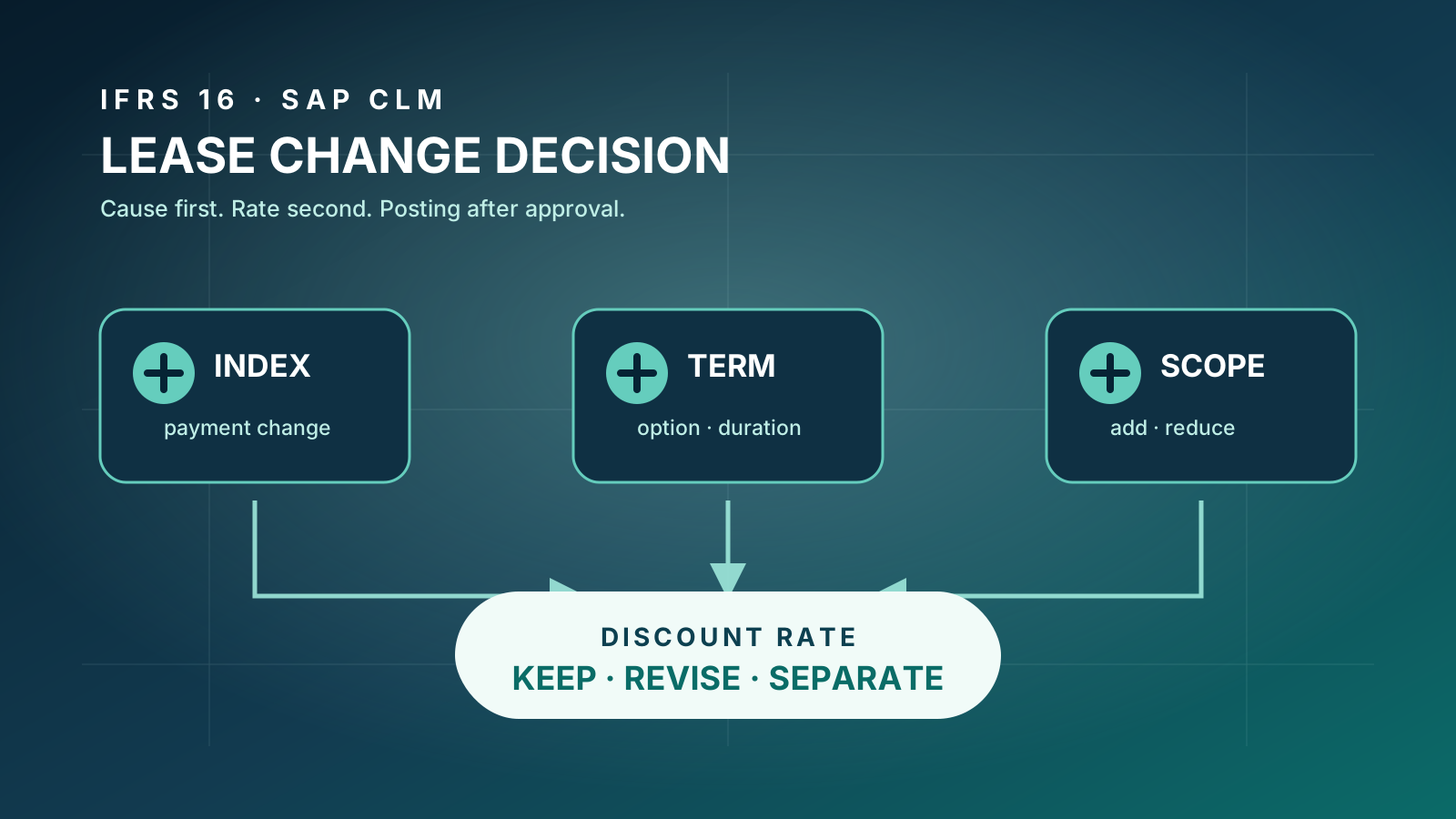
Classify the economic event under IFRS 16 first. Only then change the condition, term, cash flow and discount rate in SAP CLM.
When lease payments change, teams often jump straight to the system question: which data needs to be updated in SAP Contract and Lease Management? The more important question comes first: what exactly caused the change?
Under IFRS 16, an index-linked payment update, a reassessment of the lease term and a negotiated change in contractual scope do not follow the same accounting logic. The distinction affects the effective date, the cash flows included in the measurement, the discount rate and the treatment of the right-of-use asset. SAP CLM can execute the resulting contract and valuation processes, but it cannot replace the accounting policy and approval framework that classifies the event.
Confirmed IFRS 16 requirements
The standard provides several different routes for changes after commencement:
Index- or rate-driven payment change: The lease liability is remeasured when the contractual cash flows actually change. The discount rate normally remains unchanged. A revised rate is required only when the payment change is caused by a change in floating interest rates.
Reassessment of the lease term or a purchase option: Revised lease payments are discounted using a revised discount rate at the reassessment date.
Modification accounted for as a separate lease: Separate accounting applies when the modification adds the right to use one or more underlying assets and the increase in consideration is commensurate with the stand-alone price of the added right of use, adjusted as appropriate for the circumstances.
Modification not accounted for as a separate lease: At the effective date, the entity reallocates consideration, determines the modified lease term and remeasures the liability using a revised discount rate. A decrease in scope requires a proportionate reduction of the right-of-use asset and recognition of the related gain or loss. Other modifications adjust the right-of-use asset by the remeasurement amount.
The conclusion is simple but important: a new payment amount does not, by itself, identify the accounting treatment.
What this means for SAP CLM
SAP's documented IFRS lease-in process covers contract and valuation rules, generation of valuation cash flows, mass valuation, periodic valuation postings and reversal of valuation steps. The Valuation Management app supports valuations under different generally accepted accounting principles.
These capabilities provide the processing framework. They do not remove the need for an accounting decision before the system change is made. The process must establish:
- the economic event that occurred;
- whether only payments changed or whether term, options or scope also changed;
- the relevant effective date;
- whether the existing discount rate continues or a revised rate is required; and
- how the right-of-use asset and any profit-or-loss effect are treated.
Contract condition maintenance and IFRS 16 remeasurement are therefore connected, but they are not the same control step. Treating an index update as a modification may introduce an inappropriate new discount rate. Treating a genuine scope change as a routine condition update may leave the lease term, right-of-use asset or termination gain or loss misstated.
A practical decision matrix
| Event | IFRS 16 category | Discount-rate principle | Expected SAP CLM process |
|---|---|---|---|
| Contractual index or rate changes the payment without changing the contract | Remeasurement under IFRS 16.42 | Existing rate, except for a floating-interest-rate change | Update the condition at the effective date, regenerate the valuation cash flow and review the difference |
| Lease term or purchase-option assessment changes | Reassessment under IFRS 16.40 | Revised rate at reassessment | Document the new term or option assessment, approve the rate and rerun valuation |
| Additional right of use is added at a commensurate stand-alone price | Separate lease under IFRS 16.44 | Separate initial measurement | Establish a separate valuation scope or contract representation |
| Part of the leased area or another right of use is surrendered | Modification decreasing scope | Revised rate at the modification date | Process partial termination and verify the right-of-use reduction and gain or loss |
| Other contractual rights or consideration change | Modification, not a separate lease | Revised rate at the modification date | Update term and payments, remeasure and reconcile the right-of-use adjustment |
This matrix is a policy aid, not a substitute for contract-specific analysis. The implementation depends on the agreement, accounting policy, SAP release, deployment model and configuration.
Five controls worth designing explicitly
1. Capture the event and effective date
separately
Signature date, legal effectiveness, operational change and first
revised payment may differ. The valuation must use a documented
accounting-effective date.
2. Retain before-and-after cash flows
The evidence package should include the original and revised payment
schedules, term, options, residual value guarantees and discount rate.
This explains every movement in the lease liability and right-of-use
asset.
3. Make the rate decision an approval item
“Existing” or “revised” rate should not be an undocumented system
consequence. The file should contain the rationale, valuation date,
source or derivation and approval.
4. Link contract changes to valuation work
Every valuation-relevant change should create or enter a controlled
worklist. Conversely, every remeasurement should trace back to an
approved event. This detects both missed remeasurements and duplicate
processing.
5. Reconcile the posting to the valuation
evidence
After simulation or update, reconcile the liability, right-of-use asset,
interest and depreciation profile, and any profit-or-loss effect.
Backdated events also require a review of period status and reversal
mechanics.
Test cases that reveal process gaps
A useful regression pack should include more than one ordinary lease. At minimum, test:
- an index increase with no term change;
- a market-rent review effective at a later date;
- a renewal option that becomes reasonably certain to be exercised;
- surrender of part of the leased floor space;
- addition of space at a market-based stand-alone price;
- a backdated modification affecting a closed period; and
- parallel valuation rules for IFRS and a local GAAP.
For each scenario, define the expected classification, discount rate, revised cash flow, liability and right-of-use movement, and accounting entries before running the system test.
Open implementation questions
- Which event types and approvals are prescribed by the accounting policy?
- Which SAP functions and apps are available in the specific deployment and release?
- How are RE-FX index adjustments routed to and monitored in valuation processing?
- How are partial terminations, backdated changes and closed periods handled?
- How are IFRS, local GAAP and, where relevant, US GAAP requirements kept separate?
- Which roles may change or approve contract data, discount rates and valuation rules?
Conclusion
The decisive control occurs before the SAP posting. Classify the event under IFRS 16 first; then update the contract, cash flow, term and discount rate in a consistent way. A mandatory decision tree, explicit rate approval and a before-and-after reconciliation make remeasurements reproducible and reduce the risk that a routine-looking rent change creates a material accounting error.
Sources
- IFRS Foundation – IFRS 16 Leases, 2026 issued standard, paragraphs 36–46
- SAP Help Portal – Valuation Management App
- SAP Best Practices – Scope Item 21P Overview Table, version 2608
- SAP Best Practices – Generate Valuation Cashflow
- SAP Best Practices – Contract Valuation Mass Processing (Simulation)
- SAP Best Practices – Reverse Valuation Step
Notice: This article provides general professional guidance and does not replace project-specific accounting, legal, tax or implementation advice. Functions and availability must be verified in the relevant system, release and tenant. All information is provided without warranty.
← All news