
The strongest evidence for a lease-accounting close is rarely a single green job status. The real question is whether the complete processing chain can be demonstrated: Was every relevant lease included? Was its valuation current? Were the correct periods and accounting views posted? Do the lease liability, right-of-use asset and clearing accounts reconcile? Can an exception be traced from the financial document back to the contract?
SAP Contract and Lease Management provides specialised applications, background jobs and information-system reports for these tasks. The documented toolset includes Valuation Management (F6170), mass valuation through F6277, periodic valuation posting through F4608, the valuation-balance report RECEISBALANCE, asset-clearing reconciliation RECEASCLEARRECON, and the Lease and Real Estate Accounting Review Booklet (F8196).
Job completion is technical evidence. Close approval is accounting evidence covering completeness, period accuracy, valuation, posting and reconciliation.
What the SAP process chain actually proves
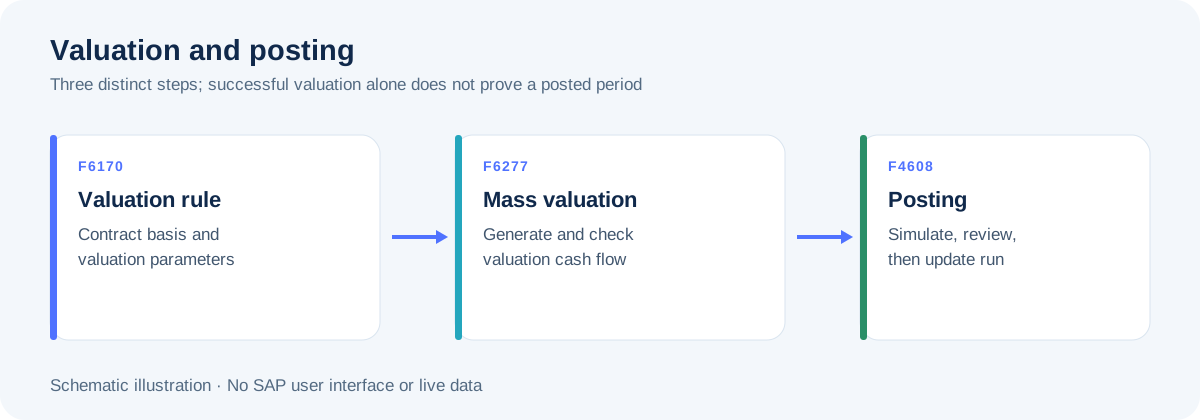
SAP separates valuation generation from valuation posting. The valuation rule is maintained in F6170; the valuation cash flow is generated for an individual contract in F6170 or RECECN, or for a population through F6277. Periodic valuation posting is first simulated and then executed as an update run in F4608. A complete valuation cash flow is therefore not evidence that the relevant accounting period has been posted.
The reports also serve different purposes. RECEISBALANCE provides valuation balances and cash-flow data, RECEASCLEARRECON supports asset-clearing reconciliation, REISREDOCCN and RERAPL support document traceability, and RERAPPCMP compares periods. No single view replaces the other control stages.
The seven controls
1. Prove the completeness of the lease population
The close starts with an independently governed expected population, not with F4608. It should include active leases, contracts starting or ending in the period, renewals, notices, partial terminations, retrospective changes and documented valuation exemptions. Expected and processed leases must be reconciled by company code, accounting principle, valuation rule and currency.
Evidence: an expected-versus-processed list containing contract, company, accounting principle, valuation rule, currency, status and exception reason.
2. Confirm the valuation rule and cash flow are current
Before posting, the cash flow must reflect all approved contract changes. High-risk events include new conditions, term and option changes, indexation, revised payment amounts, remeasurement events and retrospective corrections. Technical status should be supplemented with plausibility checks for present-value jumps, negative residual liabilities, missing future periods and cash flows extending beyond the lease term.
Evidence: the F6277 result for successful, failed and unprocessed contracts, with every exception assigned and resolved.
3. Review a simulation before the update run
F4608 provides simulation and update modes. The simulation should cover contract and line-item counts, totals by company code, accounting principle and currency, interest, principal and right-of-use movements, unexpected signs, zero values and material prior-period changes. Without predefined thresholds and escalation rules, simulation remains an executed job rather than an effective control.
Evidence: approved simulation output with quantity, amount and variance analysis.
4. Verify completeness and period accuracy of valuation postings
After the update run, the job log and result must be checked for failures, excluded leases and posting interruptions. Contract, valuation document and FI document must be linked; posting date and period must be correct; and the ledger or accounting principle must be assigned correctly. Reruns must not create unintended duplicate postings.
Evidence: job documentation plus posting reconciliation by company code and accounting principle.
5. Reconcile the asset-clearing account
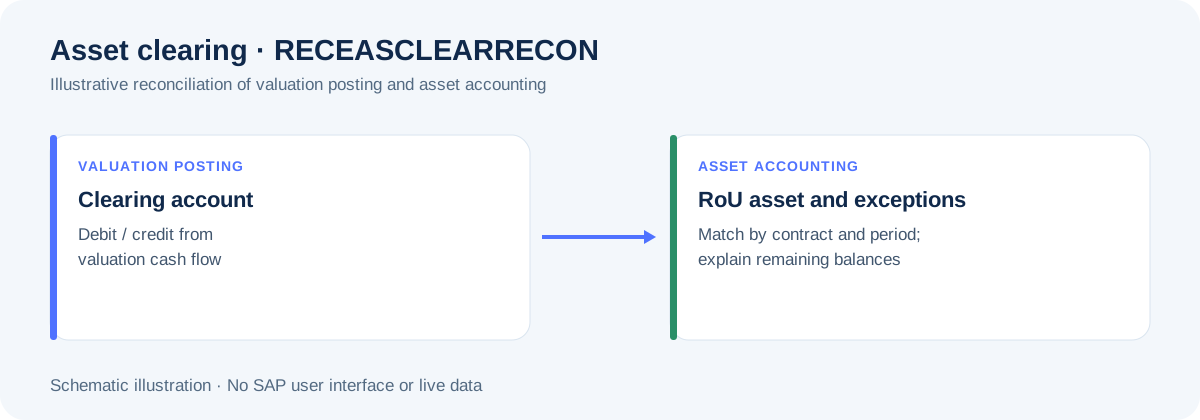
The asset-clearing account connects valuation posting with Asset Accounting. A balance may indicate asynchronous processing, a right-of-use asset failure, different posting periods, manual FI entries, incorrect account determination or incomplete reversals and reruns. Not every balance is automatically a system defect, but every balance requires a contract-level explanation.
Evidence: a clearing register showing balance, cause, action, owner and resolution date.
6. Reconcile valuation balances and contract detail
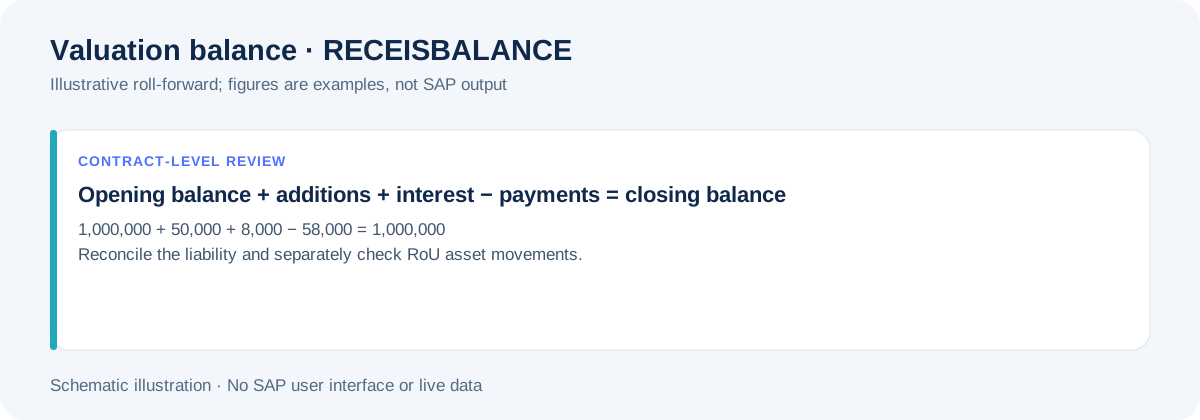
RECEISBALANCE supports contract-level review of balances and cash flows. Opening liability, additions, interest, payments and closing liability must reconcile mathematically; the right-of-use roll-forward must agree with asset movements and depreciation. Risk-based samples should prioritise high present values, long terms, foreign currencies, retrospective changes, terminations and manual interventions.
Evidence: a valuation roll-forward supported by documented contract-level samples.
7. Perform period comparison and formal sign-off
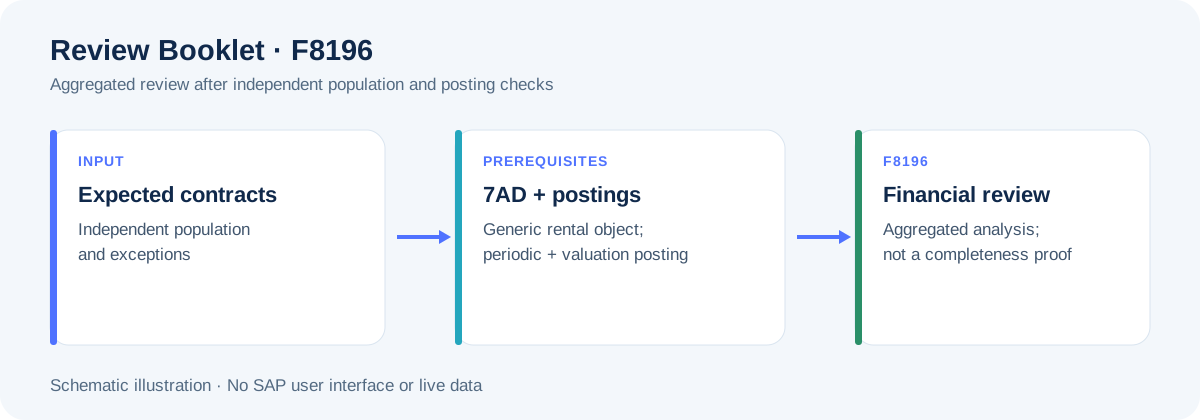
The final review explains new and removed leases, threshold breaches, and movements caused by indexation, remeasurement, termination or correction. RERAPPCMP supports periodic-posting comparison, while F8196 provides an additional analysis and validation layer.
For F8196 in SAP S/4HANA Cloud Public Edition, SAP KBA 3595605 specifies these prerequisites: a generic rental object created through scope item 7AD must be assigned, and periodic and valuation posting must have been executed, before a contract becomes visible. An empty booklet does not prove that no active valued leases exist. F8196 should not be treated as the sole population source without an independent completeness check.
Evidence: a signed close pack covering population, job status, reconciliations, clearing status, exceptions, open items and the approval decision.
Roles and governance
- Contract Management confirms the population and business changes.
- Lease Accounting owns valuation rules, processing and accounting plausibility.
- Finance/General Ledger confirms period, account and ledger accuracy.
- Asset Accounting reconciles right-of-use assets and asset clearing.
- Treasury or Accounting Policy owns discount rates and methodology.
- Control Owner reviews exceptions and grants formal close approval.
Smaller teams may combine roles, but four-eyes review should remain in place for rule changes, manual postings and final approval.
Niederhauser Consulting perspective
The decisive question is not “Is the valuation job green?” It is “Has every expected lease been valued completely, posted in the correct period, reconciled to Asset Accounting and the general ledger, and traced to supporting documents?”
A dependable IFRS 16 close emerges only when the SAP tools are tied to a documented expected population, tolerances are defined, exceptions are resolved and the outcome receives formal approval.
Sources
- IFRS Foundation – IFRS 16 Leases
- SAP Best Practices – Lease-In Accounting, Group Ledger IFRS
- SAP Best Practices – Generate Valuation Cashflow
- SAP Best Practices – Periodic Valuation Posting, F4608
- SAP Best Practices – Valuation Balance, RECEISBALANCE
- SAP Best Practices – Asset Clearing Reconciliation
- SAP Help – Lease and Real Estate Accounting Review Booklet, F8196
- SAP KBA 3595605 – Prerequisites for data in F8196
Notice: This article provides general professional context and does not replace project-specific accounting, legal, tax or implementation analysis. Scope and availability must be verified in the applicable system, release and tenant. All information is provided without warranty.
← All news