Contract Management becomes an operational workspace
The Contract Management app (F5273) combines contract overview, deadlines, renewals, status, partners, real-estate objects, conditions, posting parameters and reminders. SAP’s support for desktop, tablet and smartphone positions the app as more than a display tool.
Project implication: Before implementation, define which roles may only view contracts, maintain business data or change posting-relevant parameters. Mobile use broadens the user population and therefore increases the importance of robust authorisation and control concepts.
CLM Cost Settlement is not a complete service-charge settlement solution for the DACH region
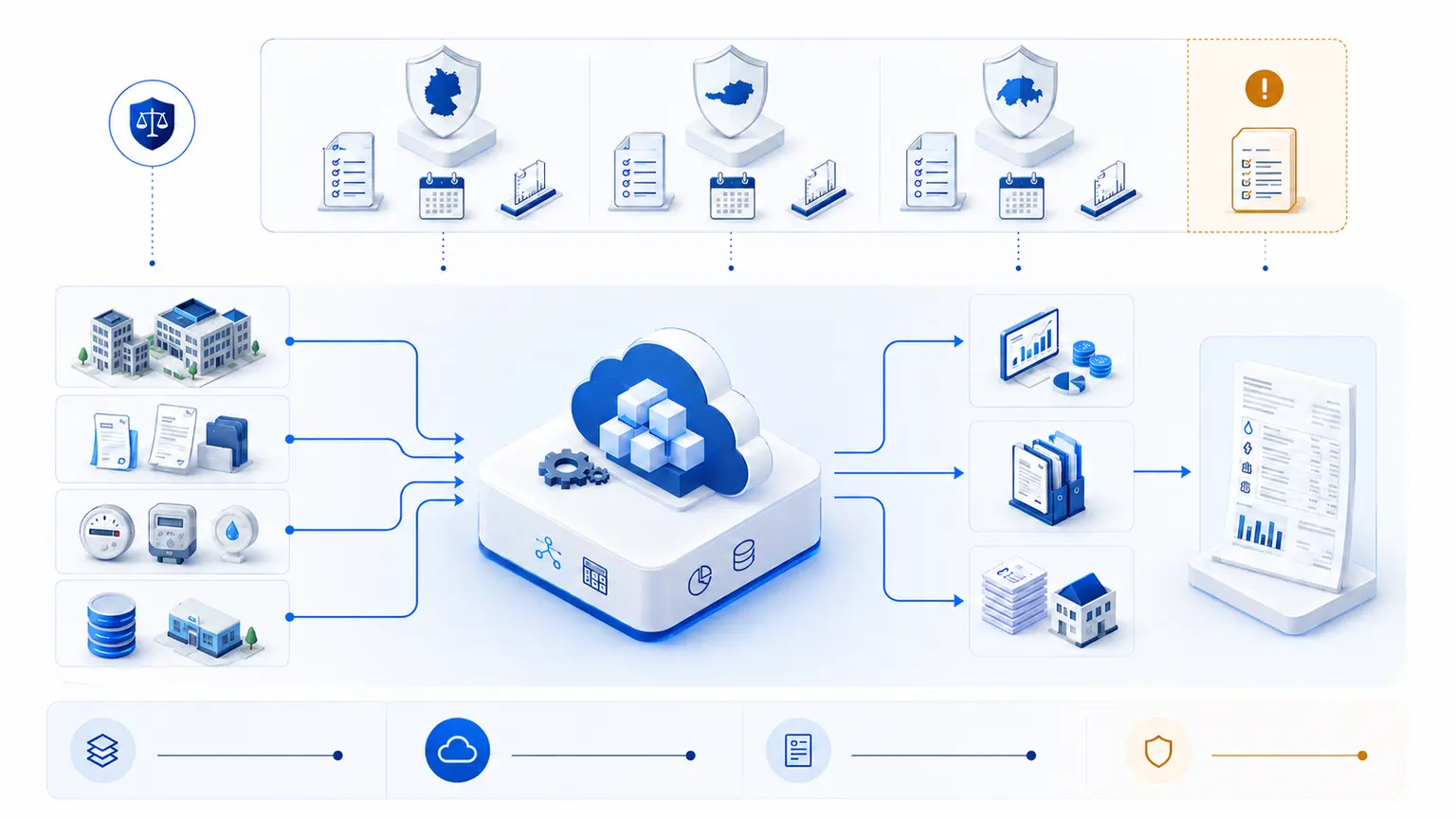
SAP calls the new function “Cost Settlement”. The documented end-to-end process allocates building expenses to tenants, processes advance payments or flat rates, integrates object and measurement data from Planon and transfers finance notifications to Financial Accounting through FIBTI. This is technical cost calculation and allocation; it does not automatically constitute a complete statutory service-charge settlement.
Based on the currently documented standard scope, CLM Cost Settlement alone cannot currently provide a complete country-specific, legally compliant service-charge settlement for the DACH region (Germany, Austria and Switzerland). In particular, SAP’s documentation does not evidence all country-specific requirements for eligible cost categories, allocation keys, deadlines, access to supporting documents, heating and consumption costs, tenant changes and auditable tenant statements as one closed standard process.
- Germany: The process, calculation, deadlines and evidence must cover, among other rules, sections 556 and 556a of the German Civil Code and the Heating Costs Ordinance.
- Austria: Depending on scope, the Tenancy Act requires the statutory operating-cost catalogue, accounting rules and access to supporting documents.
- Switzerland: The Code of Obligations and VMWG impose requirements concerning contractual agreement, actual expenditure, statements and access to supporting documents.
A productive implementation in the DACH region therefore requires a country-specific fit-gap assessment, a robust settlement design and probably extensions or complementary solutions. The new function should also not be treated as equivalent to the established SAP RE-FX service-charge settlement without detailed validation.
Project implication: First separate the tasks covered by CLM standard functionality from those remaining in a compliance, output or third-party solution component. Measurement data, settlement units, account assignment, error handling and finance transfer need a common control model across real-estate, CAFM and finance systems.
APIs, CDS views and BAdIs define the extension boundaries
For Contract and Lease Management, SAP lists released CDS views for reporting and analytics, classic and cloud-ready BAdIs for controlled extensions, and three documented APIs covering contract types, real-estate contracts and cost-allocation accounting notifications.
Project implication: These building blocks should structure the integration architecture. Standard APIs and released data models should be preferred; BAdI extensions need a documented business rationale, ownership and regression tests.
Migration planning becomes more transparent
For release 2608, SAP’s Explore Migration Objects app adds information on migration-object availability, the status of related scope items and dependencies between objects. This makes planning risks visible earlier.
Project implication: Real-estate and contract data still require a dedicated object and dependency matrix. It should record source system, data ownership, sequence, validation rules and business acceptance for every migration object.
Enterprise architecture is positioned as a continuous discipline
The new SAP Activate Roadmap for Enterprise Architecture draws on TOGAF and presents architecture as a continuous process across business, application, data and technology views. This fits real-estate organisations whose processes often connect SAP, CAFM, document management, portals and specialist solutions.
Project implication: A system-neutral real-estate process model remains stable while applications and interfaces evolve. Release decisions should therefore be assessed for process, data and architecture impact, not only for individual features.
Five concrete checks follow for current RE-FX and CLM initiatives: verify the actual 2608 scope in the relevant system, sharpen roles and controls for contract processing, define data ownership across systems, document API and extension decisions, and obtain business sign-off on migration dependencies. Release fact, project implication and open validation should always be reported separately.
Sources
- SAP Help – Contract Management (F5273), version 2608
- SAP Help – End-to-End Cost Settlement
- SAP Help – Advance Payments and Flat Rates
- SAP Help – established Service Charge Settlement in SAP RE-FX
- SAP Help – Integration with Financial Accounting
- SAP Help – APIs for Contract and Lease Management
- SAP Help – CDS Views for Contract and Lease Management
- SAP Help – BAdIs for Contract and Lease Management
- SAP Community – Explore Migration Objects, releases 2602.4 and 2608
- SAP Community – New SAP Activate Roadmap for Enterprise Architecture, 18 August 2026
- Germany – section 556 BGB: operating costs, deadline and access to supporting documents
- Germany – section 556a BGB: allocation basis
- Germany – Heating Costs Ordinance
- Austria – section 21 Tenancy Act
- Switzerland – articles 257a and 257b Code of Obligations
- Switzerland – article 4 VMWG
Notice: This article provides general professional context and does not replace individual advice. Product scope and availability must be verified in the applicable system and contract. All information is provided without warranty.
← All news